

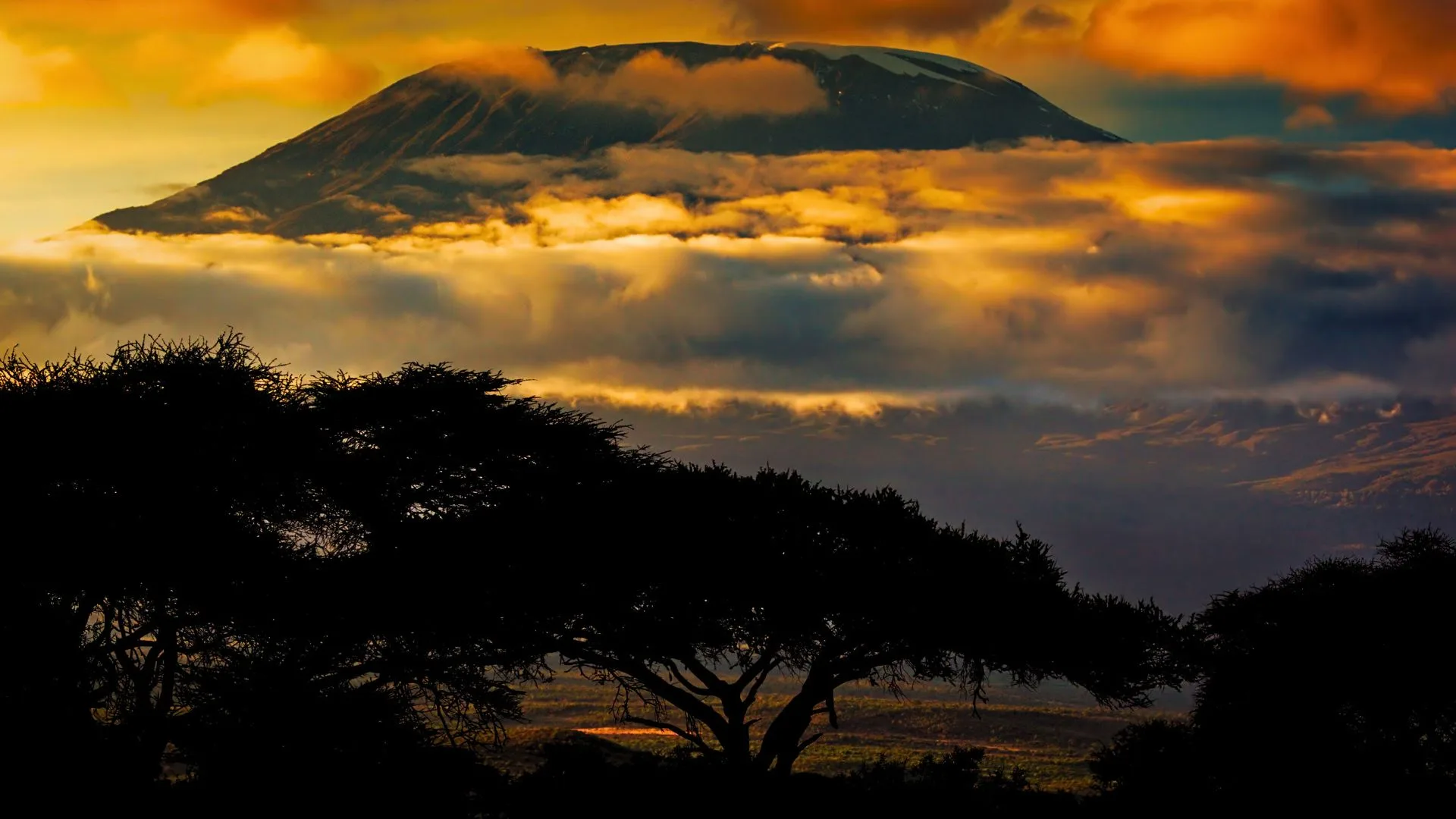
Mount Kilimanjaro is the highest mountain in Africa at 5,895 metres (19,341 feet) above sea level, and the tallest free-standing mountain in the world: it rises on its own from the plains of northern Tanzania, not as part of a range. It is a dormant volcano, one of the Seven Summits, and a UNESCO World Heritage Site. Here are the facts worth knowing before you visit or climb.
Kilimanjaro at a glance
| Height | 5,895 m (19,341 ft) at Uhuru Peak |
|---|---|
| Location | Northern Tanzania, near the Kenyan border; about 40 km from Moshi |
| Type | Dormant stratovolcano with three cones: Kibo, Mawenzi and Shira |
| Rise from base | About 4,900 metres from the surrounding plains |
| Protected as | Kilimanjaro National Park (established 1973); UNESCO World Heritage Site since 1987 |
| First recorded ascent | 6 October 1889, by Hans Meyer and Ludwig Purtscheller, guided by Yohani Kinyala Lauwo |
| Climbing routes | Seven main routes: Marangu, Machame, Lemosho, Shira, Rongai, Northern Circuit and Umbwe |
How tall is Kilimanjaro?
Uhuru Peak, the highest point on the crater rim of Kibo, stands at 5,895 metres. Kilimanjaro is the fourth most topographically prominent mountain on Earth, after Everest, Aconcagua and Denali, because it rises so far above the land around it. On a clear day it is visible from more than 100 km away, including from Amboseli in Kenya and from the road to Arusha.
Three volcanoes in one mountain
- Kibo is the youngest and highest cone, with the summit crater, the Reusch Crater and an ash pit. Its last significant volcanic activity was around 200,000 years ago, and small gas vents (fumaroles) are still active.
- Mawenzi (5,149 m) is the jagged, eroded peak to the east, a technical climb that is rarely attempted.
- Shira collapsed long ago to form the wide Shira Plateau at about 3,800 metres, crossed by the Lemosho and Shira routes.
Kilimanjaro's glaciers
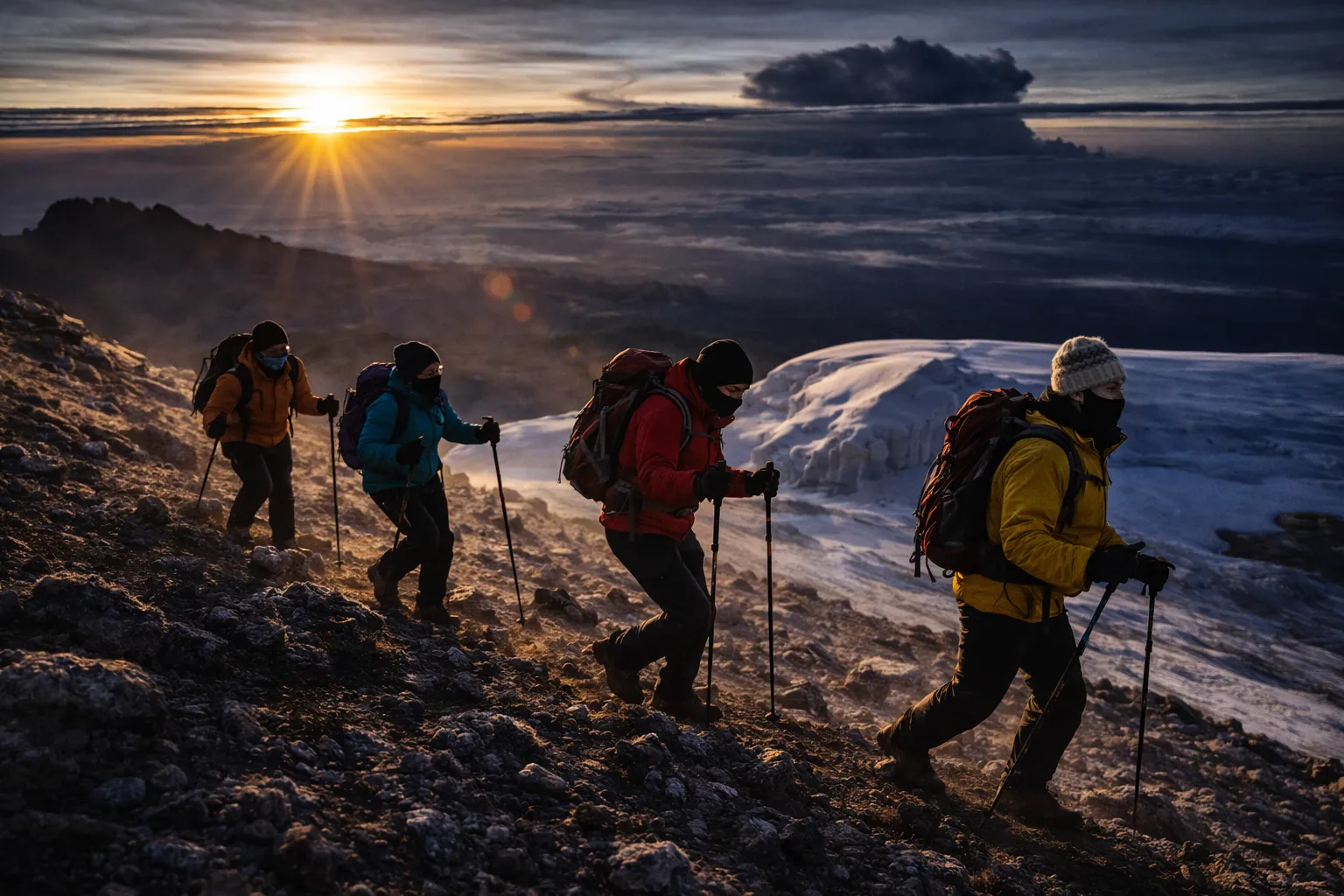
Kilimanjaro's snow cap is one of the world's best-known glaciers on the equator. Since the first measurements in 1912 the ice has shrunk by more than 80%, through a mix of drier air, less snowfall and warming. Scientists expect much of the remaining ice to disappear in the coming decades. The Furtwängler Glacier near the summit and the great ice cliffs of the Northern Icefield are still visible to climbers today.
Five climate zones
Climbing Kilimanjaro is often compared to walking from the equator to the Arctic in a week.
| Zone | Altitude | What you see |
|---|---|---|
| Cultivated land | 800–1,800 m | Coffee and banana farms of the Chagga people |
| Rainforest | 1,800–2,800 m | Giant fig trees, ferns, colobus and blue monkeys |
| Heath and moorland | 2,800–4,000 m | Giant heather, giant groundsels and lobelias |
| Alpine desert | 4,000–5,000 m | Rock, gravel and little plant life; big temperature swings |
| Arctic summit | Above 5,000 m | Ice, snow and glaciers; below freezing at night |
Wildlife on Kilimanjaro
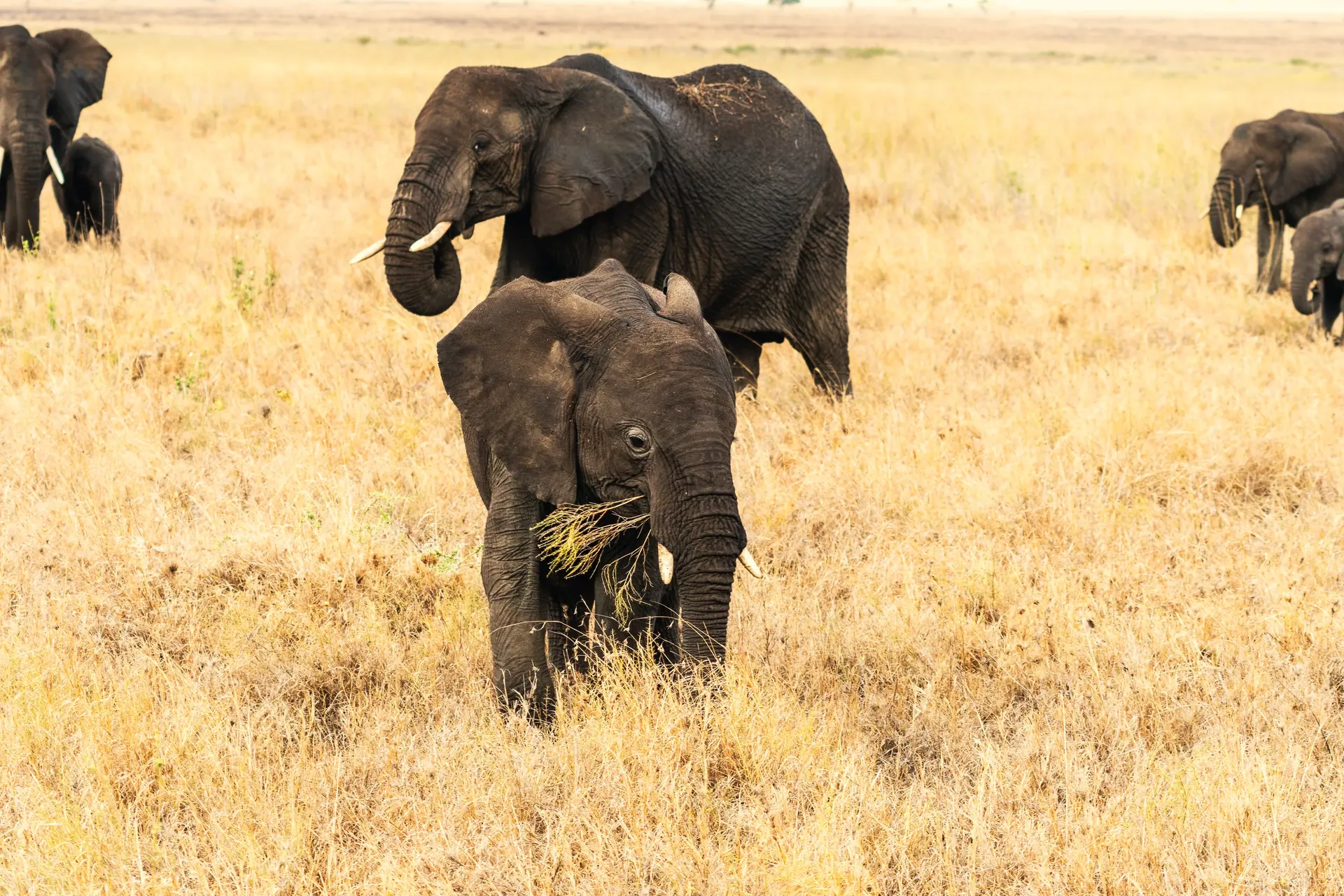
The forest belt is home to black-and-white colobus and blue monkeys, bushbuck and many birds, including the silvery-cheeked hornbill and Hartlaub's turaco. Elephants and buffalo live in the lower forests on the quieter western and northern slopes, though climbers rarely see them. Higher up, white-necked ravens and four-striped grass mice follow the camps.
The name and the people
No one is certain where the name Kilimanjaro comes from. Common explanations combine the Swahili word kilima (small mountain or hill) with njaro, possibly meaning whiteness, greatness or a spirit of cold. The Chagga people have farmed the fertile lower slopes for centuries. Yohani Kinyala Lauwo, the Chagga guide who led the first ascent, lived to more than 100 and guided climbers for decades.
Records and remarkable climbs
- Tens of thousands of people attempt the summit every year.
- Climbers in their 80s have reached the top, and the minimum age to go to the summit is 10.
- Mountain runners have gone up and down in under seven hours, a climb that takes most people a week.
Frequently asked questions
Is Kilimanjaro still an active volcano?
It is dormant, not extinct. Kibo still has active fumaroles in its crater, but no eruption is expected.
Is Kilimanjaro in Kenya or Tanzania?
Kilimanjaro is entirely in Tanzania. The best views from Kenya are from Amboseli National Park, just across the border.
Can you see Kilimanjaro from Arusha or Moshi?
Yes, on clear mornings and evenings. Moshi sits at the foot of the mountain.
How long does it take to climb Kilimanjaro?
Five to nine days, depending on the route. Read how hard it is to climb Kilimanjaro and our complete climbing guide.
Want to stand on the roof of Africa yourself? Start with our Kilimanjaro climbs, or see the mountain on a Kilimanjaro day hike.